Showing posts with label smartphones. Show all posts

Tuesday, March 25, 2014

Mobile devices enable reading in those with dyslexia - Dr. Matthew H. Schneps

Dr. Matthew H. Schneps
The widespread advent of electronic books is beginning to break down barriers that previously restricted access to high-quality content for education, needed to support the economic betterment and well being of peoples worldwide. 

Even as electronic books promise to improve access to text, many will nevertheless be unable to benefit from these advances because of neurological disabilities (e.g., dyslexia) that make reading a struggle.

In this presentation Dr. Matthew H. Schneps describe new research that shows; when handheld mobile devices capable of displaying text (e.g., smartphones) are configured in prescribed ways, many with dyslexia are able to read with less effort and more quickly, with better comprehension, making fewer errors in reading.

Virtually no training is required on the part of the reader to benefit from this effect on mobile devices.

However, for the method to work, text material must be prepared and displayed in specific ways, and this requires an understanding of the relevant parameters at play.

The Smithsonian Institution in the US has initiated an outreach program to help educators learn how to use mobile devices in this way, and are seeking help and guidance from participants of UNESCO Mobile Learning Week 2014 to help disseminate this information outside the US.

Watch the Presentation here - Matthew H. Schneps

Biography
Dr. Matthew H. Schneps is the director of the Laboratory for Visual Learning (LVL) at the Harvard-Smithsonian Center for Astrophysics (CfA).

A founding member of the Science Education Department there, Schneps has been carrying out research and outreach in science education since 1983.

He is well known for his work in educational television media that includes the award-winning programs "A Private Universe", and "Minds of Our Own" broadcast worldwide (famous for scenes of Harvard and MIT graduates struggling with concepts about the seasons).

In recent years he has been conducting research in cognitive psychology to investigate how individual differences in neurology, including those associated with dyslexia, ADHD, and autism spectrum disorders, effects how people learn science.

An outgrowth of this work is the development of an innovative technique for reading for people with dyslexia using mobile devices, research carried out through funding from the National Science Foundation in the US, and other sources.

Schneps was awarded the George E. Burch Fellowship in Theoretic Medicine and Affiliated Sciences in 2010 – 2012.

Schneps has been continuously employed at the CfA since receiving his PhD in physics from MIT in 1979.

Monday, March 18, 2013

Links to Understanding Special Needs and Technology

Here are four links to understanding special needs and technology:

If your school budget allows for only a limited number of apps and programs this year, choose the ones that will fill out your special needs collections. 
Here are some wonderful apps/websites to use with your special needs students:

Wednesday, March 6, 2013

ADHD /ADD /Dyslexia - Carl Jung

Listen to the voices of the past if they have meaning for you. Here is a quote from Carl Jung;
"The evolutionary stratification of the psyche is more clearly discernible in the dream than in the conscious mind. 
In the dream the psyche speaks in images, and gives expression to instincts that derive from the primitive levels of nature. 
Therefore, through the assimilation of unconscious contents, the momentary life of consciousness can once more be brought into harmony with the law of nature…and the person can be led back to the natural law of his own being." JUNG – CW 16 para 351

According to Jung, the person with ADD /ADHD  /dyslexia speaks the same language as, or a more direct version of, the human psyche.

He is speaking of pure thoughts and dreams that are uninterpreted and diluted by the limited use of language to describe them.

In this way they are more powerfully conceived and nurtured in the artist's brain and can be better expressed in the visual, musical and performing arts, where image, colour, sound and movement are the direct result.

We have come a long way since the closed, mystery-filled world of Carl Jung. We have changed and developed our world, making the acquisition of knowledge and the expression of ideas simpler, more acceptable and accessible for many more people.

The written language is a way to express ourselves, to relate the past, tell stories and to communicate. In the past it was our only way but now, in our multi-media, surround-around, upload-download, smartphone world, it has become much less important.


More Carl Jung Quotes here


Monday, October 1, 2012

Smartphones: EFM App - Prenatal scans help keep babies safe at home

KEEPING a close watch on baby and mother during pregnancy is crucial, but the equipment to do this is often found only in hospitals. 

So mothers who live far from medical centres must make long journeys to receive routine scans.

This could soon change thanks to a portable fetal-monitoring package based around a smartphone. 


It could provide broader access to cheap monitoring systems for those in remote locations and in countries without access to the most advanced prenatal technologies.

Designed by a team of engineers, computer scientists and obstetricians at Temple University in Philadelphia, Pennsylvania, the system uses commercially available sensors to monitor the fetal heartbeat during pregnancy or the mother's contractions during labour. 

EFM Monitoring Activity
That information is sent via Bluetooth to an Android smartphone, which processes it before relaying it to the main hospital database using whatever connections are available.

Dimitrios Mastrogiannis, the lead physician on the project, says that other health measures such as maternal oxygen saturation or blood-glucose monitors could be integrated into the system.

The work is being presented at the BodyNets conference in Oslo, Norway, this week.

Wednesday, August 8, 2012

Voice Recognition Software for Smartphones

Voice-recognition software is nothing new. But put it on a smartphone, and it comes to life. All of the frustrations of trying to control your PC by voice--fiddling for a microphone, repeating yourself again and again, resisting the urge to relent and turn to your trusty keyboard--are eliminated when you use the same technology on your mobile phone.

And it's becoming more popular all the time, thanks in large measure to the improved speech recognition capabilities of today's mobile phone platforms, such as Google's Android and Apple's iOS. But that's not the only factor behind the uptick in mobile voice recognition, says Tuong Nguyen, principal research analyst with Gartner. He cites the demand for improved user interfaces, especially from users who don't want to rely solely on a touchscreen to interact with their phone.

In addition, the increasing prevalence of laws restricting the use of cell phones while driving has fueled demand for these voice-based apps, Nguyen says. Bluetooth headsets allow drivers to talk hands-free, but many people want access to e-mail and text messages while driving, too, he notes.

Luckily, plenty of apps provide such access--and more. Here's a roundup of some of today's best voice-recognition apps for your phone.

Google Mobile Apps

Platform: Android, BlackBerry, iOS
Price: Free
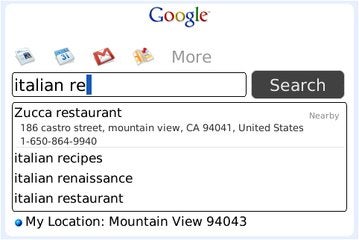
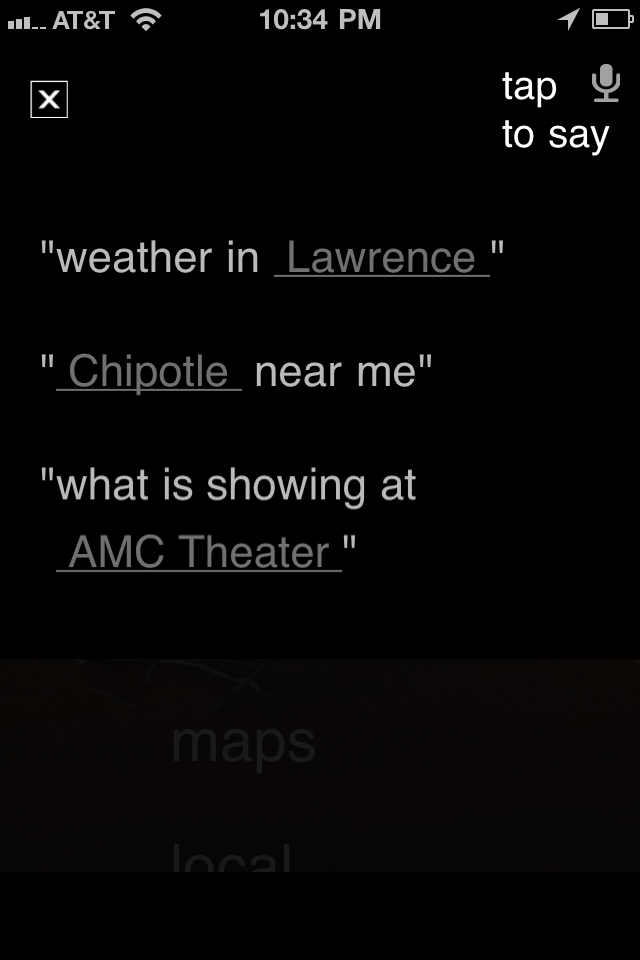
Google Search App for BlackBerry.Google Search App for BlackBerry.Whatever platform you're on, you can give your fingers a rest with one of Google's Mobile Apps. Whether you use the Google Quick Search Box on Android, the Google Mobile app for the iPhone, or the Google Search App for BlackBerry, the application lets you access the goodness of Google with the power of your voice. Search the Web, your contacts, and more without lifting a finger.
Why it's worth checking out: It's Google, duh.

Bing

Platform: Android, iOS
Price: Free
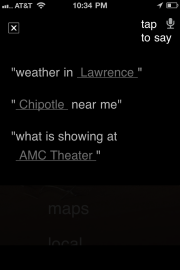
Microsoft Bing search engine.Microsoft's Bing search engine can be used with voice-recognition software and has a good-looking interface.Google isn't the only search engine in town--and it isn't the only one that delivers mobile searches powered by voice, either. Microsoft's Bing does it, too, with the same elegance that the desktop Decision Engine delivers.
Why it's worth checking out: Bing's mobile app has a fluid, elegant interface, and it looks even better without your paw prints all over the screen.

Vlingo

Platform: Android, BlackBerry, iOS, Nokia, Windows Phone
Price: Free (Basic version only; prices of Plus versions vary by platform)
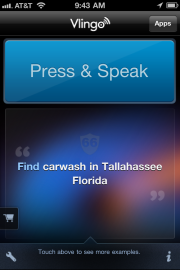
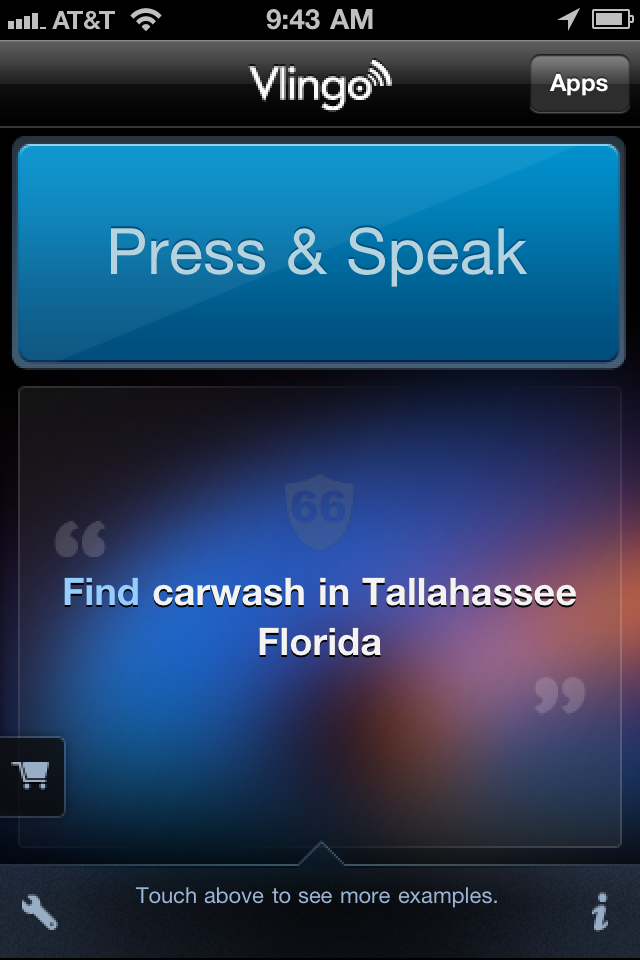
Vlingo interface.Vlingo interface.Personal assistants are not just for the rich and famous: In virtual form, they're also available to smartphone users. With versions for Android, iOS, and other platforms, the Vlingo app does your bidding, whether you want it to update your Facebook status, fire off a text message, or search the Web.
Why it's worth checking out: As MC Hammer--who is quoted on Vlingo's iOS App Store page--says, "Vlingo is dope."

Siri Assistant

Platform: iOS
Price: Free
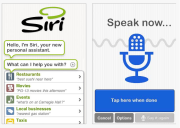
Siri Assistant for iOS.The Siri Assistant voice recognition app focuses on getting things done for you.Too busy to type? Turn to Siri Assistant, a virtual personal assistant that resembles Vlingo but is more focused on such tasks as finding restaurants, making reservations, locating theater tickets, and booking taxis. And just like a human assistant, Siri Assistant learns more about your personal preferences over time.
Why it's worth checking out: Apple purchased Siri back in 2010. Clearly, Steve Jobs sees something he likes here.

DriveSafe.ly Pro

Platform: Android, BlackBerry, iOS
Price: $13.95 per year

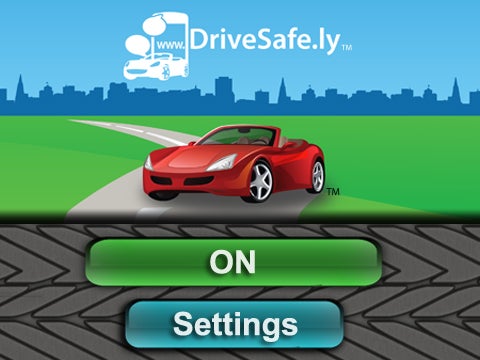
DriveSafe.ly Pro.The DriveSafe.ly Pro app reads incoming text messages to you. You can compose and respond by voice.Not only is it unsafe to text while driving, but in many places it's also illegal. Still, you don't have to be out of touch when you're behind the wheel, thanks to DriveSafe.ly Pro. This app reads your incoming text messages to you and lets you compose and send responses by voice. (A free version for Android will read incoming messages only.)
Why it's worth checking out: The app's name pretty much sums its raison d'ĂȘtre: Texting by hand while driving is not a good idea.

Dragon Downloadable Apps

Platform: Android, BlackBerry, iOS
Price: Varies
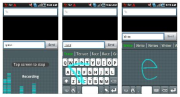
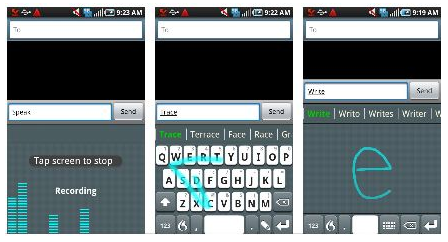
FlexT9 for Android.FlexT9 for Android.Nuance's popular line of Dragon voice-recognition software has gone mobile. The company offers various mobile apps, including Dragon Dictation (free), which lets you control many functions of your iOS device by voice; Dragon for Email (free), which enables BlackBerry users to compose and send messages by voice; and FlexT9 for Android ($4.99), which lets you choose your preferred method of input--speak, trace, write, or tap--based on your current needs.
Why it's worth checking out: Nuance's Dragon line of software has set the standard for PC-based voice recognition. If you're looking for a company that knows voice products, look no further.

ChaCha Answers

Platform: Android
Price: Free
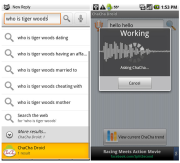
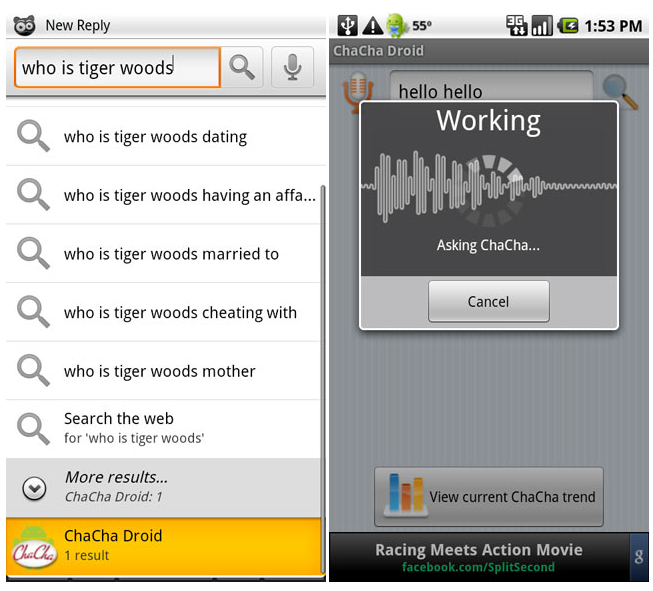
ChaCha Android app.The ChaCha app for Android phones provides quick answers to your verbal questions.Search engines are great when you're looking for a wide swath of information. But if you have a narrowly specific question, digging through multiple pages of results looking for a simple answer is counterproductive. That's when you need ChaCha Answers, a question-and-answer service that provides quick answers to your pressing questions.
Why it's worth checking out: It can tell you how much you'd weigh on Saturn--in case you were wondering.

Jibbigo Voice Translation

Platform: Android, iOS
Price: $4.99 and up

Jibbigo Voice Translation.Speak in one language and have your words translated into another with the Jibbbigo Voice Translation app.What good is talking if your intended audience can't understand what your saying? Enter Jibbigo. This two-way translation app for Android and iOS listens as you talk in one language, and then translates your words into another language. It's available in eight different language pairs, including English, Filipino, French, German, Japanese, Korean, Mandarin Chinese, and Spanish.

Why it's worth checking out: We've heard your German accent, and it's terrible. Our advice: Stop talking and let Jibbigo speak for you.

Friday, July 20, 2012

Humanising Computer Aids affects trust and dependence

Computerized aids that include person-like characteristics can influence trust and dependence among adults, according to a Clemson University researcher.

A recently published study by Clemson University psychology associate professor Richard Pak examined how decision-making would be affected by a human-like aid.


The study focused on adults' trust, dependence, and performance while using a computerized decision-making aid for persons with diabetes.

The study is one of the first to examine how the design of decision-support aids on consumer devices can influence the level of trust that users place in that system and how much they use it.

Richard Pak
The design and look of an aid are important elements for designers because of the potential dangers associated when users trust unreliable decision aids or lack trust for reliable aids simply because of the their appearance.

"Just as trust is an important factor in how humans deal with other humans, it also can determine how users interact with computerized systems," Pak said. "Trust can be influenced by the aid's reliability and level of computerization as well as the user's experience and age."

Many people interact with computerized decision aids or automation on a daily basis, whether they're using smart phones, digital cameras or global positioning systems. When automation is only reliable sometimes, a person's level of trust becomes an important factor that determines how often the aid will be used.

"Figuring out how trust is affected by the design of computerized aids is important because we want people to trust and use only reliable aids," said Pak.

Pak's research findings have revealed that the inclusion of an image of a person can significantly alter perceptions of a computerized aid when there is no difference in the aid's reliability or presentation of information.

"Humanlike computer aids provide a reduced decision-making reaction time for adults," said Pak. "A plausible explanation is that the increase in trust led to an increased dependence on the aid, which led to faster performance."

Pak's future research will examine the specific aspects of the aid that affect trust in different age groups and gender.

He also is studying the affects of the aids on users when faced with decisions that have either a high consequence, such as making health decisions, or a low consequence, such as deciding what type of computer to buy.

Pak's study was published Tuesday in the journal Ergonomics. The journal article was co-authored by Clemson researchers Nicole Fink, Margaux Price, Brock Bass and Lindsay Sturre.