A compound that prevents damage to the retina caused by diabetic retinopathy has been developed by scientists.
University of Michigan Kellogg Eye Center scientists have developed a compound that targets two mechanisms: inflammation and the weakening of the blood barrier that protects the retina that is the root cause of the disease.
Diabetic retinopathy is the most common diabetic eye disease. It is caused by changes in the blood vessels in the retina, and can cause blindness in adults.
In some people with diabetic retinopathy, blood vessels may swell and leak fluid. In others, abnormal new blood vessels grow on the surface of the retina. The retina is the light-sensitive tissue at the back of the eye. A healthy retina is necessary for good vision.
Crystal structure of Vammin, a VEGF-F from a snake venom
Until now, scientists believed that retina damage was caused by the activity of vascular endothelial growth factor (VEGF), a protein that weakens the protective blood-retinal barrier.
Drugs, created to treat diabetic retinopathy, have been desigend to block the protein but now, researchers have found that inflammation could also contribute to the disease.
"In diabetic retinopathy and a host of other retinal diseases, increases in VEGF and inflammatory factors - some of the same factors that contribute to the response to an infection - cause blood vessels in the eye to leak which, in turn, results in a buildup of fluid in the neural tissue of the retina," said David A Antonetti, a Kellogg Eye Center researcher, in a statement. "This insidious form of modified inflammation can eventually lead to blindness."
Scientists created the new compound while studying kinase C (aPKC), a protein that was common to both mechanisms as an important target in regulating the disease process.
They claim that the new compound blocks the kinase C (aPKC) protein, which in turn blocks the VEGF protein and reduces inflammation.
"This is a great leap forward. We've identified an important target in regulating blood vessel leakage in the eye and we have a therapy that works in animal models. Our research is in the early stages of development. We still have a long way to go to demonstrate effectiveness of this compound in humans to create a new therapy but the results are very promising," Antonetti said.
A rather special event recently took place at Astrium’s Elancourt site just outside Paris, when a group of visually impaired youngsters were invited for a very hands-on visit of the plant, which specialises in the design and manufacture of electronic equipment for space rockets and satellites.
Astrium attaches a great deal of importance to activities which reach out to the wider community in an endeavour to raise the profile of the space industry, explain how it works and what it contributes to the betterment of human lives.
These activities seek to connect with a number of different audiences, from decision-makers to the ordinary man and woman in the street. Making contact with young people in an inclusive manner is a priority, since they are the space engineers and the politicians of the future.
A big hit with the children was a ‘foam model’ of the Ariane 5 launcher, with which they could really get to grips, giving them a proper feel for the shape and constituent elements of the rocket. Its presence that day was serendipitous, a neat example of agile thinking on the part of Astrium’s Model Manager, who was called upon to provide mock-ups of a number of the company’s products to enliven the children’s visit. She realised that an unlikely object tucked away in a cupboard was just the thing.
Stargardt disease is a rare yet life devastating condition. It is the most common form of inherited macular degeneration, and affects about one in 10,000 people (about 30,000 people in the United States).
There is currently no cure or treatment for Stargardt disease but clinical trials using gene and cell therapies are currently undergoing.
Patients with Stargardt most often start experiencing significant vision loss during their childhood and teenage years (60% of the patients are diagnosed before 20 years of age).
This vision loss cannot be corrected by glasses, and diagnosis had been traditionally delayed due to the young age of the patients and the rareness of the disease.
After diagnosis, and depending on age at onset, vision deteriorates progressively to levels below 20/200 (legal blindness).
The disease affects mostly the central vision and spares some of the peripheral vision, although there are very severe forms that lead to complete blindness.
Almost all of those affected by Stargardt disease will live legally blind during their adult lives, although patients with late onset may retain some visual acuity.
Loss of central vision leads to impossibility to perform tasks such as reading, writing, driving or recognizing faces.
In 1997, scientists discovered that Stargardt disease results from a defective gene, the ABCA4, responsible for the synthesis of an important protein called Rim protein.
A normally functioning Rim protein transports vitamin A molecules from the photoreceptors (the molecules sensitive to light) back into specialized cells (called RPE), where vitamin A molecules are recycled to be reused for vision.
In Stargardt, the defects in the ABCA4 gene lead to partial or full dysfunction of this protein. As a result, vitamin A transport is affected and vitamin A molecules tend to accumulate in the photoreceptors.
This accumulation leads to the formation of toxic pigments (known as "vitamin A dimers") believed to be partly responsible for vision loss.
Although normal individual also form vitamin A dimers, this process usually takes decades, explaining why age-related macular degeneration (AMD) occurs later in life of normal people, while the same process takes only a few years in Stargardt explaining vision loss from childhood.
A research team from Pierre and Marie Curie University in Paris have ported technology originally developed to help robots maneuver in real world environments to Braille enabled devices that help vision impaired people do the same.
The new technology uses a pair of glasses affixed with sensors and cameras connected to hand-held devices that allow the blind wearer to “feel” the 3D environment around them.
The team from the university's Institute of Intelligent Systems and Robotics will be presenting their findings at this month’s IEEE International Conference on Robotics and Automation.
The new technology incorporates cameras and sensors initially developed for use with robotics technology, along with image processing hardware and software, to gather information about the surrounding environment.
From there though, the two technologies diverge. Instead of the data collected being routed to AI systems for use by a robot, it moves instead to a processor that converts 3D imagery to Braille signals that are passed along to real-time Braille devices in the hands of the person using the device.
The result, the team says, is situational awareness unlike anything else currently available to assist the blind in moving around without benefit of a cane, guide dog or other assistive device.
To create true 3D imagery, the system uses two cameras on each side of the glasses, which are connected to an image processor that picks out objects, edges and other pertinent details of the view ahead.
From that, a map is generated to represent the scene from the user’s perspective. That map, along with data from a gyroscope and accelerometers that provide information about speed and current location, is then converted by another processor to a series of signals that are sent to the Braille devices in the hand.
Each is a flat pad with pins that can be raised or lowered using heat, to create a virtual tactile real-time image of the surrounding environment and because the system generates new maps at a rate of about ten per second, the user is able to move, the developers say, at walking speed through a real world environment.
Only time will tell of course, just how useful the new technology will be, as those that use it will likely develop a connection with the system over time akin to the way others grow accustomed to keyboards, canes and guide dogs, and only they will be able to judge whether new systems such as this are as useful as they appear in demonstrations.
This is not the only robotics project to be
re-purposed. Software that predicts how far a robot has travelled based
on information from its on-board sensors is being modified to track a
person's movements based on their stride length.
The low-cost system,
being developed by Eelke Folmer and Kostas Bekris at the University of
Nevada in Reno would help blind people navigate around buildings using
just a smartphone.
The new system uses freely available
2D digital indoor maps and the smartphone's built-in accelerometer and
compass. Directions are provided using synthetic speech.
To help the
smartphone calibrate and adjust to a user's individual stride length,
the user must initially use touch to detect the landmarks in their
environment, such as corridor intersections, doors and elevators.
The
system will be presented at the IEEE International Conference on
Robotics and Automation in St Paul, Minnesota, in May.
David Ross at the Atlanta Vision Loss Center
in Decatur, Georgia, says that the sensing problems faced by robots and
blind people are similar but there are big differences. "Sensing
systems developed for mobile robots may have some application, but must
be adapted considerably to suit a wide variety of human needs and
situations," he says.
Today must be the day for tickling the outer limits of our senses. From the synesthetic explorations of sound through colour earlier today, we take the creative mind-bending a step further: Experiencing colour through the lack of colour.
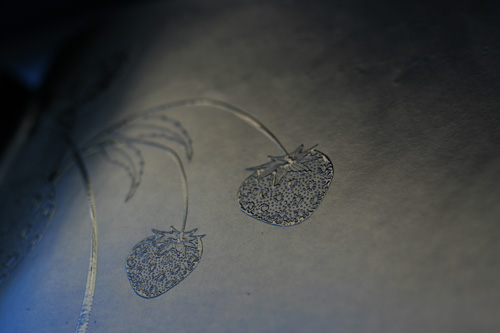
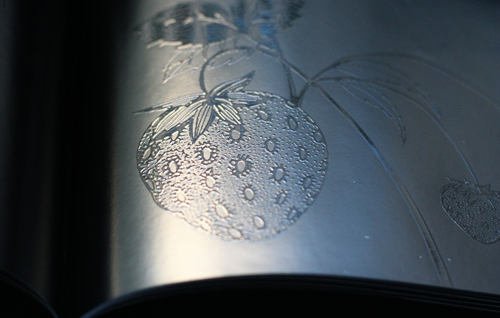
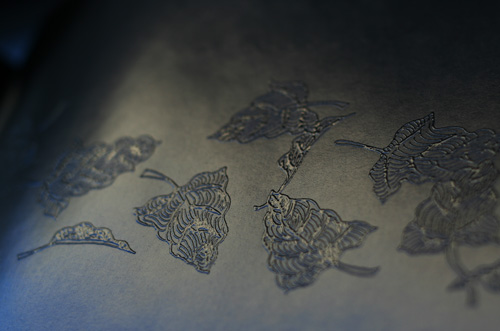
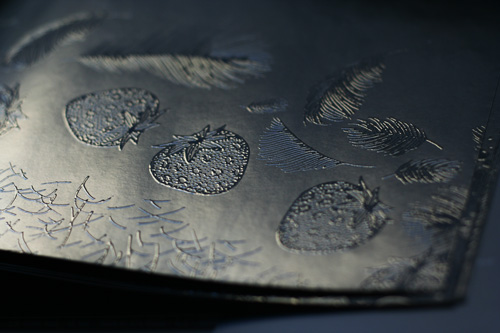
The Black Book of Colours, from author Menena Cottin and illustrator Rosana Faria, is a remarkable book of simple, elegant illustrations of natural objects, from strawberries to rain to bird feathers, depicted not through colour and shading but through embossed lines, inviting the viewer to experience them tactilely rather than visually.
The book is designed as an empathy tool that allows a sighted person to step inside the world of the blind, who experience the world through their fingers rather than their eyes.
Though intended for children, The Black Book of Colours is an absolute treat for adults, not merely as a feat of aesthetic elegance, but also as a beautiful philosophical metaphor for all those things in our lives that both are and aren’t, like the nature of reality or solitude or some great love we can touch with the tender tips of our fingers but never fully grasp.
It is claimed typing with the app is up to six times faster than existing methods for texting without sight.
Access to technology for the visually-impaired is a growing issue due to the proliferation of touchscreens.
Experts say currently available tools, such as Apple's Voiceover technology, are functional but too slow to be used effectively.
Brailletouch, which the team hope to release in the next couple of weeks, uses a system that is controlled with six fingers and, crucially, does not require any movement of the hands.
"Users who know how to type Braille well never move their hands," explained Mario Romero, lead researcher on the project.
"When users hold the phone they hold the phone with the screen facing away from them in landscape mode.
"They wrap the index, middle and ring finger in each hand around the phone.
"It's not like the Qwerty keyboard where you move up and down. That's why this thing works - we can get away with only six keys."
"This is not for texting and driving”Mario RomeroLead researcher
Eyes-free kit
Brailletouch will be free and open-source, its makers say, and it is hoped it could even become an "eyes-free" solution for fully-sighted people who want to text while visually pre-occupied with something else.
"Learning to type Braille is learning to memorise where the the dots fall," Mr Romero said.
"It took me and my colleagues a few hours to memorise things so we could start typing at around 10 words per minute. It's not something that takes years.
"We're hoping that, if not Braille, a similar system may solve the issue of having too many keys that are too small that force everybody to look at the screen when they're typing."
However, Mr Romero was quick to dampen any possible hopes that the software could be used to text while behind the wheel.
"They need to concentrate on what they're doing. This is not for texting and driving," he said.
'Truly blind'
Mr Romero highlighted a growing anxiety shared among the blind community that the widespread adoption of touchscreens for many machines and devices is making them "truly blind".
"There is extreme concern about this new trend.
"A lot of equipment today - from copying machines to machines at the gym - is all coming with touch screens."
He added that while research into tactile screens, which give users feedback by moulding, is taking place, we are still some way from having touchscreens which adequately cater for the visually-impaired.
"Blind people say I 'see' things with my fingers," Mr Romero said.




 Posts
Posts


