Showing posts with label action. Show all posts

Wednesday, July 4, 2012

7 Secrets to Improve Your Memory and Recall - YouTube


Do you have trouble remembering and memorising information? Have you invested an entire day in a seminar only to forget everything within a few weeks?

How many times do you say, "I'm sorry I forgot your name?" Now you can learn a few ideas about how good memory recall works.

Invest approximately 8 minutes and stop wasting time. Learn how to learn and retain important information.

You will increase your credibility and have an easier time building rapport by remembering names and other pertinent facts about others.

Dyslexia action: Dyslexia Still Matters - PetitionBuzz

Dyslexia Action are calling for a National Dyslexia and Literacy Strategy to enable the best evidence and solutions to be brought forward to increase the literacy standards in all UK schools. 

Our schools and teachers need our support, with access to training and expertise to better enable them to support the learning needs of children with dyslexia and literacy difficulties.

In the light of planned reforms of the Special Educational Needs system and considering other key changes, we put forward positive suggestions and solutions in our report 'Dyslexia still matters'. 


This Dyslexia Action report looks at the situation for children with dyslexia and literacy difficulties in our schools today.

It explores the progress that has been made and examines what still needs to be done to ensure school is positive and rewarding.

To read the full report, please visit www.dyslexiaaction.org.uk 


Go to Pettition Buzz to sign the petition: Dyslexia Still Matters - PetitionBuzz

Saturday, March 3, 2012

Postgraduate Certificate in Dyslexia and Literacy | Dyslexia Action

The Postgraduate Certificate in Dyslexia and Literacy programme from Dyslexia Action, is a unique online qualification designed for teachers and support teachers who wish to train as specialists in Dyslexia and Literacy.

Please read the Course Brochure before contacting us with any queries. See the link at the bottom of this page

The aim of the online Postgraduate programme is to train teachers to be informed, skilled practitioners who understand the theory and practice of teaching and assessment of learners with dyslexia of all ages. The programme offers a flexible approach to postgraduate study with personalised tutor support.

The Dyslexia Action Postgraduate Certificate in Dyslexia and Literacy programme is appropriate for a wide range of professional teachers and specialists including:
  • Teachers at all Key Stages
  • Special Needs Teachers
  • Special Educational Needs Coordinators (SENCOs)
  • Teachers and Support Teachers in Further and Higher Education and other Adult Settings
  • Teachers and Education Specialists based overseas
  • Educational Psychologists
  • Speech and Language Therapists and Occupational Therapists

Entry requirements

  • Bachelor of Arts, Bachelor of Science or Bachelor of Education honours degree
  • Recent and relevant experience in a Dyslexia Support setting
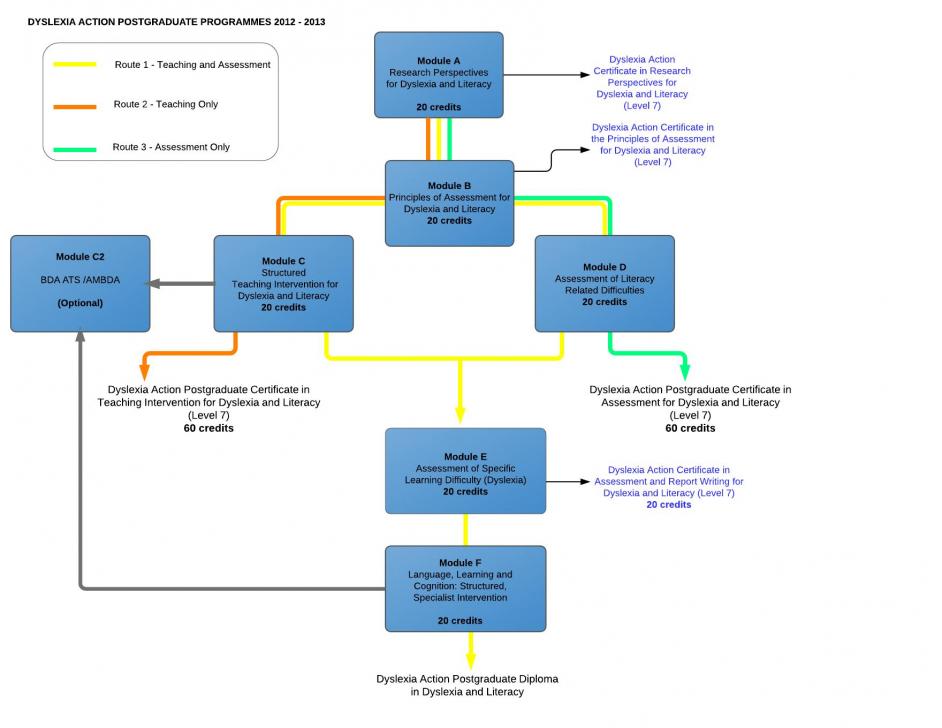
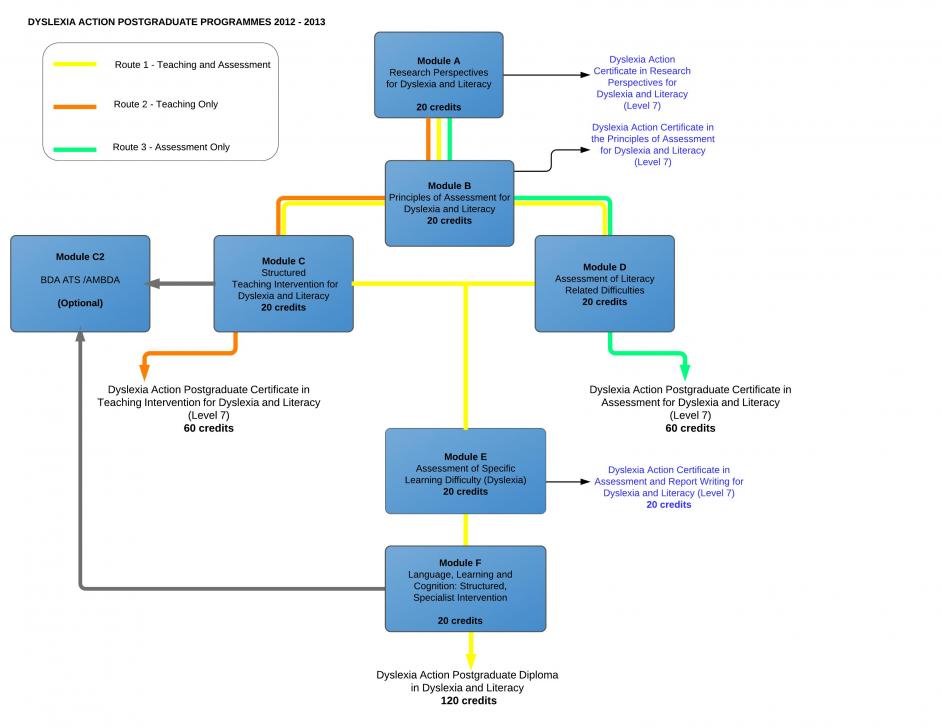
  • Qualified Teacher Status (QTS or QTLS) plus a minimum of one year's teaching experience (full time equivalent) is required for the teaching route (Modules C and C2 combined)
  • Excellent spoken and written English
  • IELTS 7 for applicants with English as a Second Language

    For further information see the IELTS website www.ielts.org
The first module of the three module course starts on Thursday, 5 April.
See the links for the Course Brochure, Fees, Dates and other useful information.
Quick Links
Personal Statement and Essay Information

Progression Flowchart

Information for your Head Teacher / Line Manager

Financial Terms and Conditions

Brochure; application/pdf iconCourse Brochure

Sunday, March 14, 2010

Parenting Skills: Trust Issues in Children

Researchers examining 'trust' issues in children conducted a study whereby children were shown a video of a ficticious game called 'daxing'. In the video shown to the children, either a boy or a man argued over the correct way to 'dax'.

The child was then asked to play the game 'dax', and the method they chose to use was recorded. Children were also shown a puppet, who interjected and said it was his time to 'dax'.

The Puppet's role
I find the inclusion of a puppet very interesting in this study. I believe that the puppet here represented a non-threatening neutral or objective character, neither adult nor peer and therefore exerted little or no social pressure on the child.

It had no established role, except that of an object that had a social status equal to, or lower than the child and therefore, can easily be addressed and controlled by the child. Perhaps moreso than his peers, perhaps not, but I digress.

To return to the study, the puppet performed 'daxing' either in the way the boy in the film or the man in the film did it, and the children's reactions were recorded.

Results

The researchers found that the children imitated the adult's method of 'daxing' significantly more often than they imitated the boy's method.

Children were also more likely to intervene when the puppet performed 'daxing' using the boy's method, protesting that the puppet was 'daxing' wrongly.

Lessons Learned

The results from the study suggest that children prefer to learn from adults rather than other children when it comes to rule-governed activities like learning a new game.

They also expect other people (the puppet) to learn and perform actions in the way that the adults have defined. This is demonstrated by the expectation that the puppet would also follow the adult's actions and not the boy's and consequent protests if it did not.

Social Norms

These findings tell us many things. Firstly, that young children will more readily accept adult's instructions and behaviour as being right, in normal circumstances and that adults' behaviour should be copied and followed or repeated, accordingly. Certainly, if the other choice is to listen to or comply with their peers or, heaven forbid, a puppet (other people).

This has wide spread implications for social learning of both good, bad and corrective guidance and behaviour in children and adults, especially for parents. The basic expectations of the children are that their parents are the leaders, good role models and positive examples to be trusted, obeyed and followed.

For more information on the study click on the link to the British Psychological Society (BPS)